VISITS

Showing posts with label dock. Show all posts

Monday, 9 September 2013

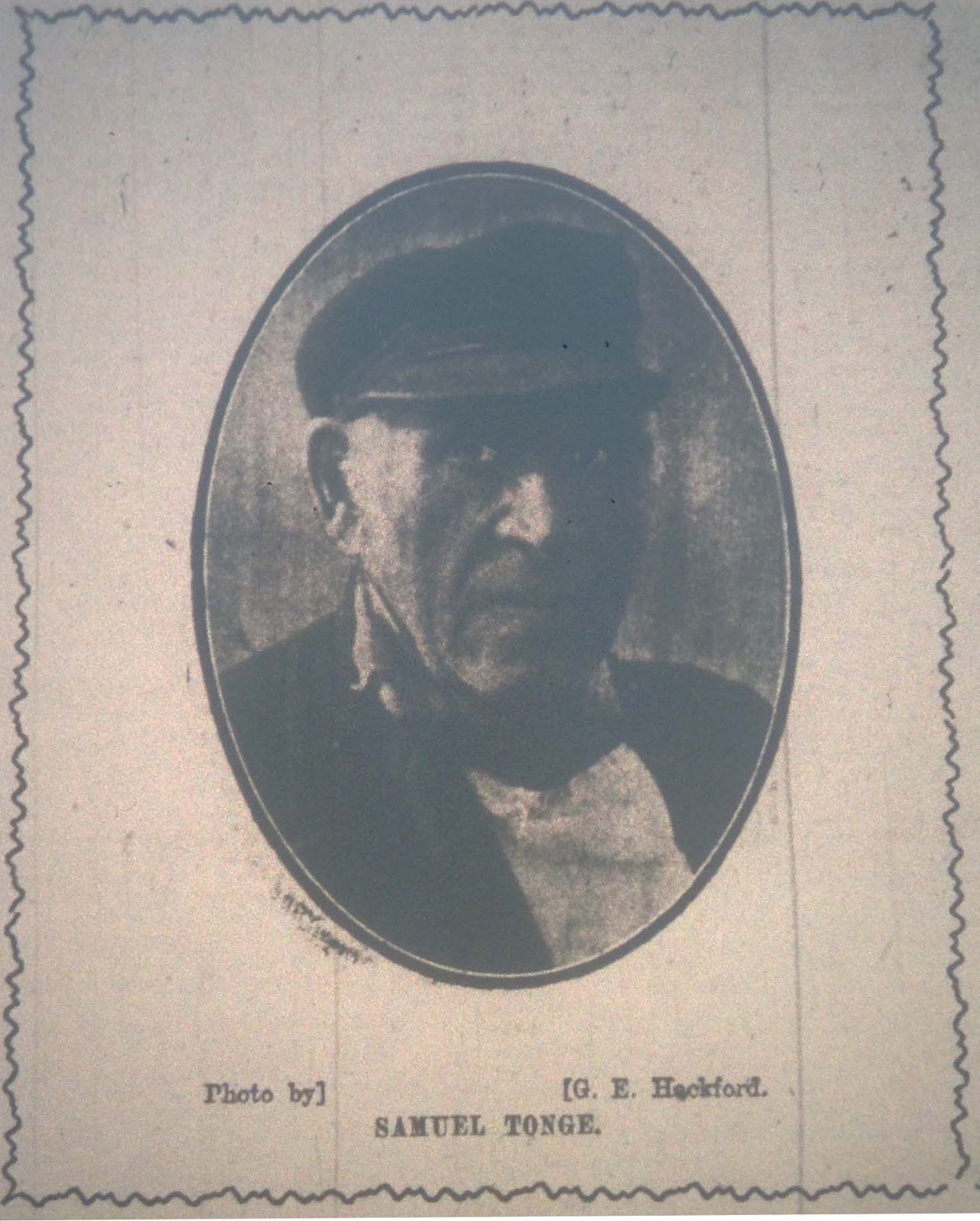
Sammy Tonge

In 1909 Samuel Tonge was Boston's oldest worker. Everyone who knew him and admired him called him Sammy and he was 87 years of age in 1909. When he was 3 months old his parents moved to Boston from Peterborough where he was born in 1822. His father was an agricultural labourer and Sammy's life was rough and hard, but he weathered every storm and enjoyed the best of health. He was at work every day, employed by the Corporation to look after the cleanliness of the pontoon on Boston Dock, and his work was a credit to himself and to those who employed him. The conscientious manner in which he discharged his duties was known to everyone who had business at the fish dock.
When he was a boy he worked for Mr Jones, a Cooper, in Rosegarth Street, for a shilling a week. At that time the price of bread was Elevenpence 'aipenny per quartern loaf and onion gruel was the popular fare at  breakfast. He and his parents were then living in the now departed "Groom's Alley*" Subsequently he went to work with his father on the land, and later was employed in a brickyard in Butt Lane*.


He didn't take to carrying bricks and so he ran away to sea. He went on Mr J. King's fishing smack for a start he was 13 years of age at that time. Afterwards he served on the "Daisy", of Boston, under Captain Lister, trading between Boston and Stockton, carrying corn from Boston to Stockton, and coals from Stockton to Boston. Then he was on the "Blessing", with Capt. Sissons, trading between Boston and Lincoln, and later he was mate of the schooner "Ellen," of which Mr. Baldwin was the skipper. He continued to go to sea until about 1889 when he obtained his position with the Corporation.
By 1909 Sammy was living with his son Chris, in Tuxford Terrace, Mount Bridge. He had been twice married and by his first wife he had four children all of whom were dead. He had been on a voyage in the "Princess Royal," of Hull, and returned from Oporto to receive the news that his wife and children had died during his absence. His second wife had died 16 years previously and by her he had 10 children, seven of whom, four sons and three daughters, were living, plus he had 29 grandchildren.
He was known to like singing his favourite song "The Lass o' Glasgow Town," and was once a champion hornpipe dancer.
The old age pension had just been introduced and asked if he had one he replied, "What do you think? I can earn my own living. I am an old sailor!" 

Groom's Alley is unknown to me.
Butt Lane is now Carlton Road.

Monday, 15 July 2013

The Convict Ship "Success"


In September 1901 the ship "Success" visited Boston Dock. In a career spanning 106 years, the Success served as a merchant ship, emigrant ship, penal hulk housing men, women, and boys, explosives and store hulk, and finally, exhibition ship. She toured the world for the most part successfully for fifty years. As a sailing vessel her career is unparalleled. For an incredible span of 106 years she voyaged the world’s oceans and waterways. There are no truly reliable figures, but it is believed that tens of millions of people trod her decks. She has witnessed scenes of both immense happiness, and unspeakable suffering and death.

The "Success", this photograph was not taken at Boston.

On board her men, women, and even children have been imprisoned, couples have been married, and U.S. Marines recruited. She has transported indentured servants to work on sugar plantations and poor farmers to a new life across thousands of miles of ocean. She has seen wild parties and beauty contests. Her visitors have included royalty, movie actors, politicians, and numerous other celebrities. She has been both praised by politicians and preachers as example of "man’s inhumanity to man" and an object lesson in prison reform, and vilified as a fraud and a hoax. She’s even been called "The World’s Most Hated Ship"! She has been sunk, grounded, rammed and burned, and until time finally caught up with her one fateful day in 1946, her nearly indestructible teak hull always survived.

Thursday, 4 April 2013

Prostitution in Boston.

Let me say from the outset that I went in the New Park Inn many times in the 1960's and 70's and it was no different from other pubs in the town except that it was full of Merchant seamen, German, Dutch, Norwegian etc. and of course the girls, but not once did I see anything happen in there that doesn't happen every night of the week in any pub or club in "modern" Boston but in those days the pub and the girls who went in there had a bad name. All I remember is having a good laugh and joke in there.

The New Park Inn, centre left with the balcony.

In the 1970's a report said "Prostitution is alive and well in some parts of the town though not often glimpsed by local people because the handful of women who are well known by the police confine their activities to the dock area."
Gordon Eady, Boston's senior probation officer said, " Prostitution in Boston is one of those things that no-one will admit, although everybody knows it happens. If you asked anyone in the town which public house you should go into to find prostitution I don't think there's one who would have any doubt at all."
He said he felt prostitution was probably made easier on the docks in Boston because they were open, unlike some private docks in other towns and cities, and he knew of groups of girls from other towns arriving at Boston dock because they knew they would not be prosecuted for trespassing as they were in other places.

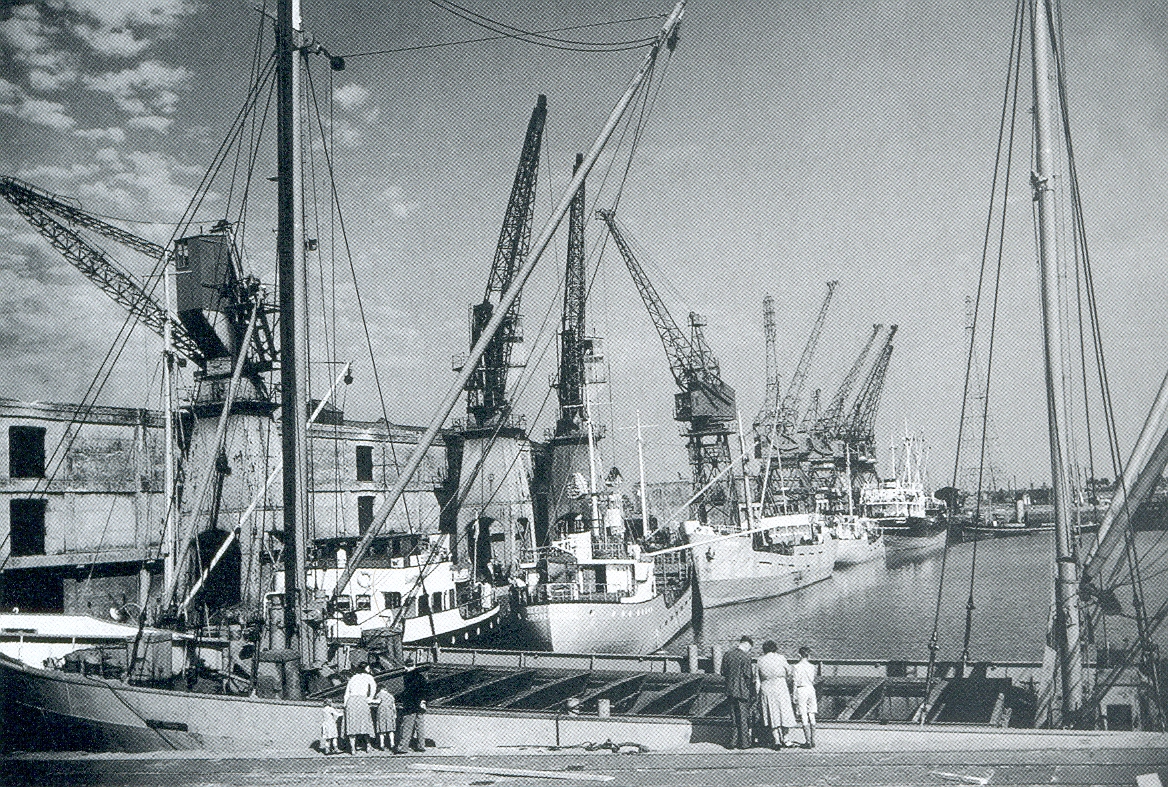
When the dock was "open" and families visited.
 
He went on, "Prostitution is generally seen as an easy way of life and there are second generation prostitutes in the town, daughters having followed mothers way of life."
He said he did not feel there was any big time organisation behind the prostitution and as probation officers he and his colleagues had contact with a number of the girls who had appeared before the courts for brawls and assaults at public houses, thefts and other allied offences.
A Boston taxi driver at the time said, "There are at least 10 of these girls, who are well known in the town, and they often operate from council houses and flats in several parts of Boston. I sometimes take girls and their clients from the boats to the girls homes, and then I get early morning calls to go and pick these chaps up to take them back to the dock. Their clients were always foreign seamen, and very few local men would go with these girls."
He added, "I think it's a fact that certain girls work certain boats, they have their own territory, and get a bit nasty if they find another girl has gone on their particular boat. It's a funny way to live," he said, "but the way I look at it is that at least while there is this type of girl in Boston, the decent girls are safe to go out."
The chief executive of Boston at the time said, "turning the council owned dock into a closed dock will not cut down prostitution. Sailors being sailors want women, and some women, being what they are, are prepared to provide a service. Over the ages, wherever there is a seaport, there has been this demand for prostitution."


Chief Supt. George Bulman, head of the Boston Police division said, "They are nicely contained in the dock area, there is no soliciting on Boston's streets, ordinary people don't see anything of it and I don't think it is a problem. It is just a small handful of women that are known to us, probably not more than about eight. As for the dock being open, if anyone thinks having a closed dock would make any difference to what goes on they must be living in cloud cuckoo land."

THE GIRLS HIT BACK
 
The girls of course hit back at the condemnation of their profession. Mrs X, a middle aged divorcee said, "I don't know why anyone should complain about us - we don't upset the ordinary people of Boston." She added, "Nobody sees anything they shouldn't, and we don't bother anybody. It's not as if we walk round the Market Place accosting men.
 
Boston Dock.
 
Plenty of people know what I do for a living, and they don't shun me. We're perfectly normal, it's just work to us, it's not the easiest way to make a living but it's the only way we know."
It had been said that there were concerns for the safety of the children of the prostitutes and some of the girls were incensed when they heard about this.
Mrs X continued, "Most of the girls' children are in care, and the ones with small babies look after them well. They are always prepared to pay for a good babysitter while they're out."
The remarks about mothers and daughters "on the game" was also incorrect said Mrs X, and she herself was the only one she knew of with a daughter working as a prostitute. Although she agreed that most of the prostitution was confined to the dock area she also said that there was also a lot going on in other parts of the town. The girls did not have territories on the dock as had been suggested by a Boston taxi driver although many of them had regular seamen. "I have known many girls who have met and married seamen," said Mrs X, "and they have a good and happy life together. Prostitutes make the best wives because they've had a wide experience of men, and they know how to choose the right man for themselves. Once they have chosen a man they are loyal, and stand by him."
There was anger too at the remarks made by the taxi driver, and the girls said it's not fair to slag them when the driver has been making good money out of them. The driver also claimed that local men had nothing to do with the prostitutes but Mrs X said, "Of course they do, I have been with plenty of them but I wouldn't mention any names because it would break up marriages."
Mrs X said she first went "on the game" after she and her husband parted and she was unable to get a job. She added that now she was getting older she had begun to "ease off a bit" and was hoping to settle down within the next couple of years. She thought it a pity that prostitution was not as it was on the Continent, "We could do with a Union, too," she said. "You'll never stop prostitution, not while men are prepared to pay for sex," she added.
 
The New Park Inn, one of Boston's old pubs.

Friday, 11 January 2013

New year oddments.


Bryan Lea sent me a link to the following picture of the tug " Finlay " under construction at Scotts Bowling's yard on Clydeside  in 1913. Finlay was the resident tug at Boston Docks for many years. 


Above: The Finlay.
Below: A Victorian ribbon plate with the Stump on it.


Below: The Municipal Buildings in a traffic free West Street !!

Below: A steam engine belonging to Crawfords of Frithville, nr. Boston.


Thursday, 30 August 2012

Tidy up

Just found a few bits and pieces while cleaning up my hard drive so have put them together to tidy them up.

 
Barrett's old premises in Witham Town.
 
 
The old "Danger Slow" sign at the bottom of Sluice Bridge that was used before the traffic lights were put up.
 
 
The Hospital Lane footbridge over the Maud Foster showing it was cast at Butterley in 1811.
 
 
A Boston painting.
 
 
The old Main Ridge painted street name near Pump Square.
 
 
Painting of Boston.
 
 
The Stump.
 
 
The Stump and river.
 
 
A painting of the dock.
 

Wednesday, 13 June 2012

Boston Society Magazine

The "Boston Society" magazine ran from September 1899 to August 1902, here is a glimpse of the things it told us.

In the fashion column women were told not to wear bathing costumes that show too much skin and were advised that a black bodice and knickerbockers, worn beneath a short skirt that reached to the knee was neat and fashionable.

In the sports column Boston Cricket Club batsman W. Kitwoods total for the season was 218, and the best of the bowlers were Chambers, MacIntyre and Langley.

There appears, too, the interesting life story of Captain Rehoboth Robinson (not a Bostonian, but born in Lincolnshire) who at the time lived at No.1, Intrepid Cottages, Skirbeck, who was one of those who went in search of Sir John Franklin. He had been nine times wrecked, his wife was drowned at sea, he served in the Russian war and had two winters in the Arctic. He sailed in 100 ships, rising from cabin boy to master-mariner and ship owner and saved as many as 40 people from drowning.

Regarding the arrival of the telephone in Boston we read "The telephone has not been embraced as it ought to have been for at present only 17 machines are used in the town".

A scheme, which never came to be, is referred to in one issue - the proposal to introduce electric tram cars into the town. It was proposed by "The British Electric Traction Company Ltd.". The idea was to run trams from the junction of Brothertoft Road and Sleaford Road to the end of Spilsby Road and from the Dock to the Railway Station. Objections were raised by the Corporation and after a period of negotiation the project fell through.

There is also an article on Hussey Tower (below), which tells us, among other things, that the old ruin is believed to be haunted. The writer also states that in its time it has been used as a mill, a brewery stables and a sail making factory and at one time it was contemplated turning it into a gaol.

Friday, 11 May 2012

The Dock site 1882

Mr. Walter Whyers (looking bck in 1935) remembers the beginnings of Boston Dock in 1882.

Mrs. Simonds, wife of the Mayor, cuts the first turf.

" I was present at the ceremony of turning the first sod for the commencement of the building of the dock. I well remember the grand time we had, the public tea to the school-children, the sports and the fireworks, but the most vivid recollection I retain of the building of the docks is taking a walk with three or four other lads to look at the progress that was being made during the excavations. On our way back we walked through the derelict gardens that had been attached to the old windmills. The ground was littered with planks, huge stones and heaps of earth and clay, dumped there by the navvies.

The two windmills that were demolished to make way for the dock.

There were, however, still a number of redcurrant bushes that appeared to have determined to let their last crop of berries be the most plentiful that they had ever borne. Since no one seemed to own them, or take the trouble to gather them, we set to and had the most glorious feed of fully ripened fruit that I ever remember having partaken of. The currant bushes would be situated near the centre of the present dock."

Tuesday, 3 April 2012

SEA SERPENT?

In August 1903 there was a lot of excitement at Boston Dock when a sea creature was landed there from the steam trawler "Indian" belonging to the Deep Sea Fishing Co. It was described at the time as "a monster of the deep, having the body of an elongated flatfish and a head shaped like a horse's." The creature was brought up in the vessels trawl during the  night-time on the fishing grounds off Iceland.
It was just over 8 feet long and between 8 and 10 inches deep and the body was so flat that when laid out it scarcely rose 2 inches above the board. Running the whole length of the body was a series of fins and the tail itself was small in proportion to the body but the most remarkable thing about the monster was its head which was horse shaped. The eyes were large, about 3 inches across and the body was smooth and grey coloured with no scales about the head. Captain Johnston, of the trawler "Indian" said that when the animal was hauled aboard the body flashed in the darkness like a piece of silver.
It was displayed on the Fish Pontoon at the dock and after a lot of bidding it was sold to a Mr. H. Randall for 14 shillings (70p) and afterwards moved for exhibition at Skegness. The older fishermen of Boston said they had never seen anything like it and local naturalists were at a loss as to what it might be.
So what was it? Well, Mr. G.E.Hackford, photographer of Boston, sent a photograph and letter to the Natural History Museum in London and received this reply.
"The fish represented on your excellent photographs, which I am very pleased to keep, is the Deal Fish (Trachypterus Arcticus), a pelagic fish of wide distribution, already on record from Iceland and from various points on the British coasts. Yours faithfully, G.A. Boulenger."
So there we have it, no sea monster brought to Boston but still an interesting story. The picture above shows what a Deal Fish looks like.


Friday, 30 March 2012

Artists inspired by Boston.

Boston has inspired many artists over the years, here are just a few of them.


The Stump by Arthur Huston


The Gallows Mills (demolished when the dock was built) by James Rowell.


The Stump and riverside by J.M.W. Turner.


Spitfires flying over Boston, signed "Tovey".


The Stump from Haven Bank by Jim Sorrell.


The Maud Foster Windmill by an unknown artist.


The Stump by William Willoughby.


Friday, 23 March 2012

W.B.THOMAS


At the present time (March 2012) the Guildhall museum has an exhibition featuring the painter William Bartol Thomas (1887-1947) who was born in Boston. Here are a few of his paintings.


The Market Place.


Above and below: Two views of the Dock.


Above and below: Two river views.


The Stump from out of town.


Sunday, 11 March 2012

SOME PHOTO ODDMENTS.


Here are a few pictures that I can't find stories for at the moment, I hope you enjoy them.


In 1978 this lorry got stuck when the driver tried to get out of Mitre Lane in Bargate.


One of the many sets of cards given away by Beaulahs of Boston with their food products.


The Railway Mission Hall was in Fydell Crescent. Marriots Motors offices were built on the site and thankfully Marriotts kept this stone and built it into the new property.


The sixties group The Animals, on stage at the "Glider"


The last commercial sailing vessel to leave Boston Dock.


Some Boston nick nacks for the tourist trade.


An old Vesta case (match case) showing the Boston Coat of Arms.


An old picture of Carlton Road School.


Houses that were pulled down in Duke Street.


Looking out onto the Market Place from the Peacock and Royal window, note the Rum Puncheon in top right corner.


The Peacock and Royals curved window on show at the Guildhall.


Lord Nelson's Field in about 1966, built on its place now is the Nelson Way Industrial Estate.


Buildings on the corner of Pen Street and Main Ridge, demolished when John Adams Way was built.


The building of John Adams Way in the 1970's, with The Ram pub at centre right.


An old potato weighing machine used in the old hand-picking days.


The demolition of the Regal Cinema in West Street.


This is the Zion Church which was itself demolished and the Regal built on its site.


An old Lincolnshire Road Car bus and below an old Sharpes bus.


And finally some more nick nacks.