In the 1920's Bostonian James Ladley (popularly known as Buck) lived in Caroline Court. Of medium build his tanned skin spoke of an open air life, and his street performances fascinated the crowds in the town. He would allow himself to be tied up in ropes from which he would free himself in an incredibly short time, he would break a piece of glass between his teeth and calmly chew and swallow the larger pieces, he would chew coal and brick and with his two hands bend double a piece of steel half an inch in thickness. Asked how he came to start such an occupation he said that he was out of work and had nothing to eat so he thought he would try to get some money in an honest way, and that is why he went on the market. As previously said, he used to get tied up and free himself in a certain time without undoing the knots. One May Day market two farm labourers, out for a days fun, tied him up and said they would give him five shillings if he could get free within 20 minutes, he told them to put 2/6d each in the ring and he would shake hands with them. They put the money in the ring and as they did he just gave his hands a twist, the ropes fell loose, and he shook hands with them as promised. On another occasion he was doing his turn on Bargate Green when someone in the crowd challenged him as to whether he actually swallowed the glass, the man bet him £5 that he didn't. Buck hadn't the money to cover the bet but another market man lent him the money. Next came the question of how to prove that he really did swallow the glass and it was eventually decided he should undergo an X-ray examination at Boston Hospital, the loser of the bet to pay the cost of the X-ray too. He went for the examination and proved to the satisfaction of the man that there was nothing fake about it and went home that night with £5 in his pocket. Another time a man said to Buck that he could chew glass as well as he could so he thought he would give him a try, he asked the people in the crowd to be witnesses of the fact that the man had agreed to do it at his own risk and they agreed. Buck chewed his into powder and swallowed it and then came the mans turn, as soon as he got it in his mouth he began to bleed and Buck took it from him and dressed his mouth with iodine. The injured man put his hand in his pocket and gave Buck 10 shillings and whenever he passed Buck afterwards he threw 2 shillings in the ring. He took £11 odd that day at Beedall's corner.
After each performance he took two or three teaspoonsfuls of a celebrated golden syrup which cleared all the glass and coal dust out of his system He once had an offer to join the Circus but said the money was not enough in comparison with the risk and so he refused.
In his younger days he was a good boxer, wrestler and a weightlifter, he claimed that when he was 18 he could lift a quarter of a ton and when Fisher Clarks factory was being built he carried five 1cwt bags of cement (a quarter of a ton) tied together from the lorry to inside the building.
He would have been born in about 1889 as in 1935 he was 46 years old and a labourer on the dock. By this time he had not done his "magic" in eight or ten years because certain people in authority did not look with a very favourable eye on his performances in the public streets because of the possible effect they might have on the younger generation but, as shown to a reporter of 1935, he could still bend the steel and lift a 4 stone weight (56lbs) above his head with the little finger of his right hand.
Showing posts with label hospital. Show all posts
Showing posts with label hospital. Show all posts
Sunday, 16 September 2012


Tuesday, 17 May 2011
Neglecting Boston's history
The neglect of Boston's history is nothing new, when the Court Room in the Guildhall was dismantled in 1878 an old turned oak balustrade was removed and for the next 33 years formed part of Mr. G.E. Hackford's garden fence on the Haven Bank !!
 Fortunately in June 1911 it was rescued by the Boston Antiquarian Society and given to the Corporation and it was hoped that the old balustrade would find a resting place in the Peoples Park (near the old General Hospital and swimming baths) where it would be a suitable addition to the memorial archway (pictured below) made from the oak timber removed from St. George's Hall in the 1890's. I don't know if they actually did this with the balustrade, maybe someone out there knows?


Friday, 6 May 2011
The past looking down on us
I took all the following pictures within the last couple of months which proves that the past is all around us if we look around.





This drainpipe is on the house next to Rob and Jan's shop in High Street, we have guttering older than the U.S.A. !!!


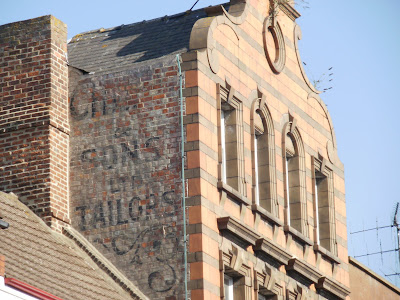
Cheer's and Son's, the tailors, traded for years in West Street (in the premises now trading as West Street Furnishings) and their painted sign can still be seen on the brickwork.

Johnson's Seeds, established in 1820, once had a shop where the Waterfront pub is now.

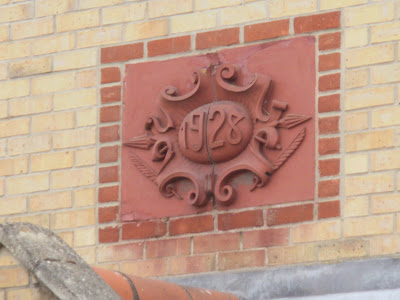
Above and Below: These date plaques are from the old General Hospital and have been put into the houses that were built on its site.

Below: And a bit further on are the old Corporation Baths.

Wednesday, 2 March 2011
Lincoln Lane Area
During the 1960’s the Lincoln Lane area (almost opposite the Stump on the other side of the river) was demolished in preparation for redevelopment.

The area included Irby Row, St. George’s Lane, Lawrence Lane, Leicester Square, Pinfold Lane, Stanbow Lane, Rosegarth Street and Lincoln Lane itself. Earlier demolition and the passage of time had already brought Lincoln Lane to its knees and from 1932 to 1961 between 75 and 100 properties had been pulled down by the Corporation or by their owners.

Many of the buildings and homes were up to 200 years old and four of the Stanbow Lane cottages were once used as a hospital.

When it was built the area was a prosperous place, boasting among other homes, two or three large merchant’s houses and gardens. It was mainly residential but later a few pubs (the Stag and Pheasant, the Hop Pole, the Victoria, the Blue Lion etc.) appeared as well, and then, as slum clearance produced waste land, shops were built and industry edged a foot in the doorway, including the shoe lace factory of Arthur Whittle and Co. Ltd., a slaughterhouse, George White’s saleroom and even the Fire Station had its home there but by 1961 there were fewer than fifty houses occupied.

But what of the residents in 1961 that were told they would have to leave? At the Victoria Inn, Mrs. Agnes Berry, wife of the landlord said, “I’m not really bothered, but I know most of my customers are” she also looked back at some of the characters of the area she knew, there was Topper, (a chimney sweep who sported a top hat) Shetty, Weary butterfly, Sooty Sue, Old Pol Simpson, Old Nel Drury……….
At 13, Rosegarth Street, lived Tom and William Cushley, brothers (at 66 and 70 respectively) and both retired Corporation dustmen. Tom had won the Military Medal in the First World War and it was his fourth home in the area. He said, “We’ve both had 35 years on the ash carts. We live here happily together. It suits us and we’re never badly*. Course we don’t want to move!” “I spent four years out in France without a scratch. Now, after five years here they want me out, and it’ll be the fourth time.”
At 16, Rosegarth Street, Mr. and Mrs. W. Hough, with a growing family, took a different view. Said Mrs. Hough: “We’ve always lived in old houses and it will be a pleasure to get away from this and into a decent one. We’ve no bath and no electricity, and the place is damp.”

At her grocers shop in Lincoln Lane, Mrs. May Peacock, was worried. “I’ve been in this shop for 24 years, the ground opposite has been waste all that time and we want to know definitely what’s going to happen, and when. This shop is my living.”

*In Boston “never badly” means you’re never ill.

The Blue Lion on the corner bottom left, and the Victoria Inn on the far right corner.


The cottages that were used as a hospital in Stanbow Lane.

Part of Lincoln Lane.
At 13, Rosegarth Street, lived Tom and William Cushley, brothers (at 66 and 70 respectively) and both retired Corporation dustmen. Tom had won the Military Medal in the First World War and it was his fourth home in the area. He said, “We’ve both had 35 years on the ash carts. We live here happily together. It suits us and we’re never badly*. Course we don’t want to move!” “I spent four years out in France without a scratch. Now, after five years here they want me out, and it’ll be the fourth time.”
At 16, Rosegarth Street, Mr. and Mrs. W. Hough, with a growing family, took a different view. Said Mrs. Hough: “We’ve always lived in old houses and it will be a pleasure to get away from this and into a decent one. We’ve no bath and no electricity, and the place is damp.”

Rosegarth Street.

The corner of Stanbow Lane and Pinfold Lane.
So, back to today, it was all eventually “rejuvenated” and on the characterless, red-bricked site now (2011) among other things are the Police Station, the Department of Employment, an empty Kwik-Save supermarket and the Bus Station.*In Boston “never badly” means you’re never ill.
Monday, 20 December 2010
The General Hospital
I was asked if I had any pictures of the General Hospital, here are the few I found.

Boston General Hospital was down South Terrace, it looked out onto the Bath Gardens, or "Old Park" as we called it when we were kids, it was established in 1871 in temporary premises as the Boston Cottage Hospital.

A new building was erected in 1874 and was extended on several occasions.

The name was changed to Boston Hospital in about 1887, and Boston General Hospital around 1937.

The Hospital was administered from 1948 by the Boston Group Hospital Management Committee of the Sheffield Regional Hospital Board.

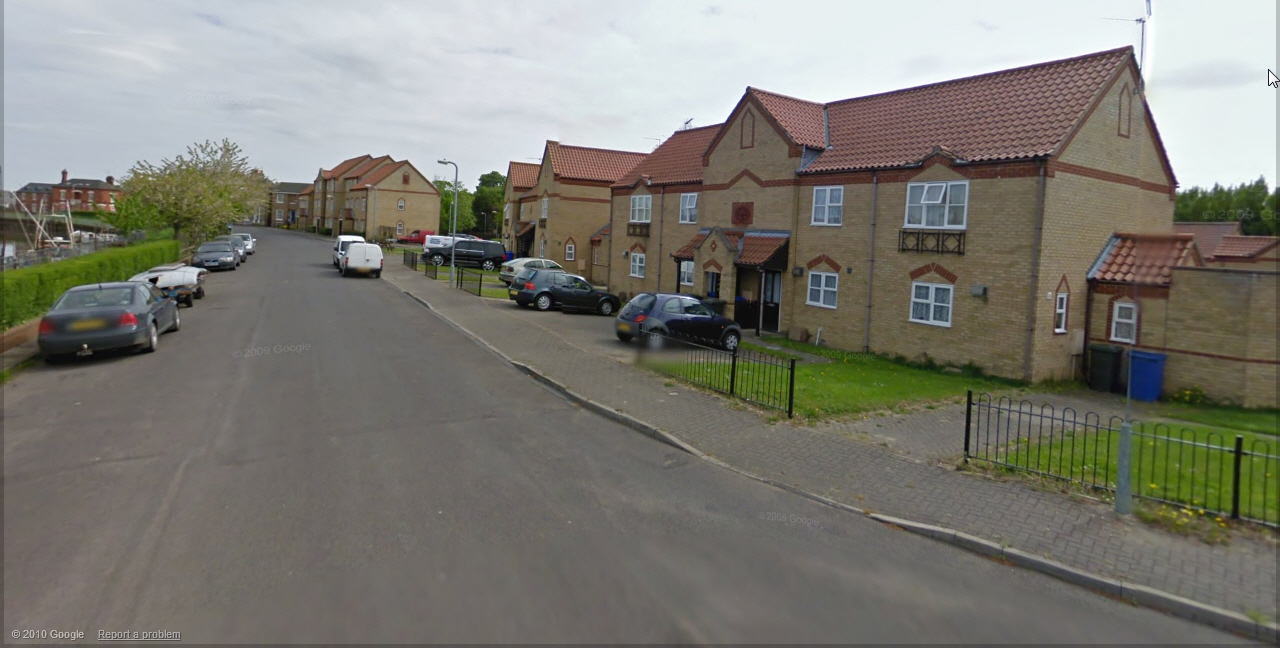
The Hospital was replaced by the new Boston Pilgrim Hospital, opened in 1971, and this is the site today, a housing estate.


Subscribe to:
Posts (Atom)