VISITS

Friday, 28 September 2012

The Germans.

At the start of the First World War in 1914 there were two German brothers living in Boston who had been naturalised Englishmen for twenty-three years. The brothers, George and Leonard Cantenwine owned a butchers shop in High Street and late on the first Saturday night of the war a crowd attacked the shop because it was rumoured that customers had heard them expressing pro-German sentiments.
All the windows were broken and the shop looted and several of the attackers were later charged, surprisingly one of these was Alfred Harlow, another butcher.

 
Recruiting in the Market Place 1914, when there was hatred toward the German people of the town.
 
When he gave his evidence, Leonard Cantenwine asked the magistrates to be lenient and later several Boston people wrote to the press and expressed sympathy for the Cantenwine's and disgust with the rioters. In the first week of August 1918 when the war had gone on for four long years, an unsigned letter appeared in all the local papers explaining why the local farmers had not supported as well as had been expected the War Savings Campaign that summer. The writer pointed out that 'Germans' were living in Boston and had purchased farms near the military aerodrome at Freiston Shore. Leonard Cantenwine did own a small farm at Freiston and had recently bought a second at Leverton. The letter also accused these Germans of going to these farms daily in order to spy and hinted that they were preparing to assist in a landing of German troops on the coast. The writer was soon identified as Mr. Joseph Bowser J.P., also chairman of the Boston Branch of the National Farmers Union.
The Cantenwines had had enough and decided to defend themselves and started an action for libel against Mr. Bowser, The case wasn't heard until June 1919 when the war was long over. Many witnesses appeared for Mr. Bowser and they retold every little event of the war involving the Cantenwines in an attempt to show that the brothers supported Germany despite their naturalisation and, therefore, that Mr. Bowser's comments were basically true. Miss Bristowe, a barmaid at the White Hart and Walter Woodthorpe the coal merchant, told how Leonard Cantenwine in 1914 had forecast that the Germans would win the war and that he would become 'Burgermaster of Boston'.
The jury took only twenty five minutes to decide that Mr. Bowser's letter was defamatory but that the words used were fair comment on a matter of public interest. The Cantenwines were ordered to pay the entire costs of the case and it is no wonder that they soon left Boston.

Thursday, 27 September 2012

Boston Hoaxed.

In 1921 the following was found in an old cutting book which, sadly, was dateless. The Peacock is mentioned and in the 1880's this hotel was renamed the Peacock and Royal after a son of Queen Victoria stayed there so it was obviously pre this date.

"................a military hoax was perpetrated on the Mayor and town of Boston (Lincolnshire) a good many years ago, and which made the town the laughing stock of the countryside for a good many years. One day a gentleman of smart bearing and military appearence arrived at the police station and asked to see the superintendent of the police. He informed this gentleman that he was Captain X--, and had arrived to prepare quarters for 500 troopers who were on the road, and would arrive in Boston the next day. The superintendent took the Captain to the Mayor, and the latter gentleman hastily summoned some of the Aldermen, and it was decided to give the troopers a public welcome. In the meantime the Captain, escorted by the superintendent, went to the chief hotel, the Peacock, and arranged for the officers quarters there, giving very generous orders right and left, even to the killing of several sucking pigs.


Every hotel and inn of the town was requisitioned, and the butchers were soon busy killing extra beasts and sheep. The Mayor decided that it would be the proper thing to meet the troopers on horseback, and invited those Aldermen and Councillors and prominent townsmen who could ride to do the same. The Mayor, leading the way with a numerous suite, all on horseback, started early, and reached Kirton, the first village south of Boston. There they waited, several hours elapsed, but no troopers ever arrived, and at last it dawned on the whole of the people assembled that they had been hoaxed, and very badly hoaxed too, as the captain had cashed numerous cheques which, like the soldiers, were bogus. Some of the butchers were very badly hit, and meat and provisions were very cheap for several days after."

Wednesday, 26 September 2012

The Victoria Pub.

In March 1920 an objection was put before the justices against the renewal of the licence of the Victoria Beerhouse in Rosegarth Street. The objection was that there were twenty five lodgers living in only six rooms. The statement evidently "staggered" the Mayor who, when he pointed out that there were only six bedrooms, the landlord replied that there were three beds in each room. Six times three equals eighteen the Mayor said and the landlord complacently remarked that they were double beds!

The area of Boston now occupied by the Police Station, old Quik-Save supermaket, Jobcentre etc. By the time this picture was taken most of Rosegarth Street had been demolished.
 
The Chief Constable stated that the licence was unnecessary and the renewal was not desirable. He said that in Lincoln Lane and Courts leading out of the lane, from the corner of Stanbow Lane to the Mission Schoolroom, a distance of 186 yards, there were 68 inhabited houses, three of which were licenced - The Blue Lion, The Victoria and The Duke of York. In Rosegarth Street there were three licenced houses, The Victoria, The Stag and Pheasant and The Hop Pole.
Inspector Swain said that he had known The Victoria for over 30 years and during the last twelve years had frequently visited the house. The class of trade he said was very rough and men and women from various parts of the town went there. On more than one occasion he had spoken to the landlord (George Henry Brady) about the conduct of the house. Brady, the Inspector added, had been too lenient with his customers, and they had got the upper hand of him. J. Broughton of 29 Lincoln Lane, a second hand furniture dealer, said he had been a regular customer for 43 years and that half the customers were local residents, and the volume of trade spoke to the necessity of the house. Evidence was also given by James Wm. Bull of Rosegarth Street, and Walter Vergin, boot repairer, Rosegarth Street. Fortunately for the customers the licence was renewed but the Mayor said they might give a warning as to that particular house, for further guidance.

Tuesday, 25 September 2012

Boston United stuff.

Thank you to Andrew Butler who sent me the following.
 
Boston versus Gak-Graz, April 1954.


The Standard saluting Utd beating the football league club Bradford Park Aveune in the FA Cup in the 20's.
 
 
The club mascot in the 1950's.
 
 
This is one of Andrew's oldest programmes from 1927.......and as he rightly says even I can't remember that far back!!!!

Sunday, 23 September 2012

September snippets.


This building, near Goodbarn's Yard in Wormgate, was once owned by the Barnard family and the large arch gave access to a riverside wharf. The family were brewers and owned a lot of public houses. They were also merchants who opened a bank in the 1790's but on 27 June 1814 they became the first bank in Boston to fail.

--------------------------------------------------------------------------------------------------------------------------


An old football programme advertising many forgotten Boston businesses including the Spick 'n' Span cafe, the Loggerheads pub and Cream Line Taxi's.

--------------------------------------------------------------------------------------------------------------------------


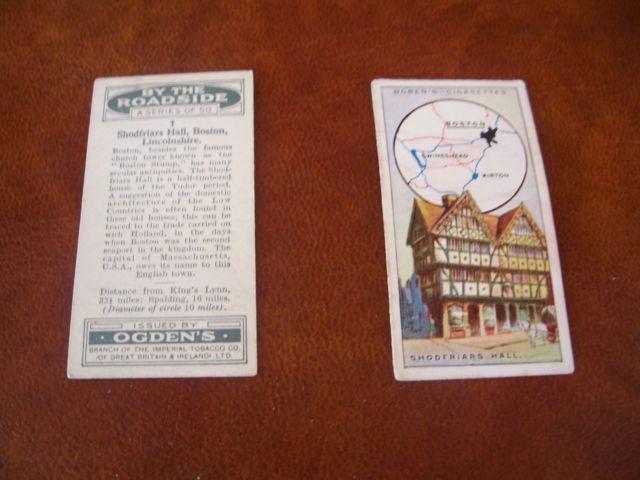
A cigarette card issued by Ogden's, a branch of the Imperial Tobacco Co. and showing Shodfriars Hall Boston.

--------------------------------------------------------------------------------------------------------------------------


An unusual view of Boston Market Place showing a flag flying from the top of the Stump.

--------------------------------------------------------------------------------------------------------------------------

Thursday, 20 September 2012

Some oddments.

Ellen Colam.

Mrs. Ellen Colam was born around 1843. Ninety two years later in February 1935, and living in Liquorpond Street, she shared her memories of Boston in the "old days." She chuckled as she recalled the taunting of the gypsies during her childhood who used to camp where Woodville Road is situated now. She talked about some of the murders which took place in Boston during her younger days, remembering the poisoning of Peter Mawer by Catherine Wilson (who was later hung for another murder) and also that of a little girl who went to a school which was near Hussey Tower, and who was murdered on her way home.


She had some interesting reminiscences concerning smuggling which used to be very rife in the town, and described how an infuriated crowd broke the windows of the house occupied by a man who had "split" on the smugglers.
But Mrs. Colam was also well aware of the modern things that were happening in 1935 too and listened to the wireless regularly being especially interested in the recent launching of the Queen Mary.

--------------------------------------------------------------------------------------------------------------------------
The Willoughby Road Almshouses.
 
These almshouses  were built for 10 poor men and their wives in 1874, they are on the site of an earlier almshouse known as the hospital of St Leonard. The hospital of St Leonard, for ten poor people, was established at Skirbeck in c1220 and was given to the Knights Hospitallers in c1230 and became known as St John the Baptist 's Hospital. In 1338 it supported 20 people in the infirmary and 40 at the gate, where alms (usually food or money) were distributed. In 1542 it was granted to Charles, Duke of Suffolk. The hospital appears to have continued as an almshouse, as in 1608 St Leonard's Hospital and `beadsmen' are mentioned.


--------------------------------------------------------------------------------------------------------------------------
 
Sarah Swift.

Sarah Swift was born on the Blossom Hall Estate in Kirton Skeldyke, about 5 miles from Boston, in 1854, the daughter of a tenant farmer. Trained as a nurse she rose to the position of Matron of Guy’s Hospital in London, retiring in 1909 but was recalled at the outbreak of the First World War to be Matron-in-Chief of the joint War Committee of the British Red Cross in the Order of St.John.

Known as the ‘Mighty Atom’ she gave devoted service during the war and in 1919 became Dame Grand Cross of the Order of the British Empire. After the war she founded the College of Nursing which later became the Royal College of Nursing in 1947. She died in 1937 at the age of 83. A ward at ‘Guy’s is named after her and she is remembered in Kirton in the Lady Chapel of the Church.
 
 
--------------------------------------------------------------------------------------------------------------------------




Wednesday, 19 September 2012

Boot and Shoe Laces.

Viewed from the outside the premises of Arthur Whittle and Co. looked small but this feeling was lost as soon as you passed through the double entrance doors. Passing through the office you came first to the stock room packed high with laces of every type all in smart boxes for the wholesale market and in the room above was the weirdest machinery. Imagine a room full of steel tables each bearing a huge "figure eight" composed of spindles and bobbins and you have the fundamental idea. Each "figure eight" represented a machine capable of turning out two endless laces, these passed on to another machine to be wound and duly cut into regulation lengths.


View from the Stump of Whittles Bootlace Factory.
 
On the same floor was the packing room and here nimble fingered young ladies handled and boxed the laces, no factory rule barred them from talking and they could also sing if they wished, which they often did.
In the days before the First World War the monopoly of the trade was for the main part in the hands of Germany and Austria, but Whittle's captured a large market and sent its products all over the country.
Before the premises became a lace factory they were occupied by a Mr.Fred Jackson who carried on business as a feather merchant, and rumour has it that it was here that the first Cheavins' filter was made many, many years ago.