VISITS

Wednesday, 25 September 2013

End of month round-up.


In 1910 the Swastika was a good luck symbol and nobody had any idea what it would mean 30 odd years later.

 An old Boston postcard.

 An auction on Fish Hill near the Assembly Rooms.

 A 1912 advertisement for Shales and Ainsworth, coal merchants.

 Holland Brothers.

 Advert from 1911.

 Advert 1911.

 The old Town Bridge photographed in 1911, showing cracks that had appeared.


Tuesday, 24 September 2013

Down among the dead men.

There are many people in Boston who are unaware that there was ever a church called St Aiden's Chapel of Ease down high-street, let alone that it had a crypt.

The Chapel of Ease. High Street.

Thanks to the courtesy of the Rev F H Duggins, M.A. in 1912, a "Boston Guardian" representative was allowed to inspect it and also to take photographs of one or two of the more interesting items.
The crypt extended right under the main floor of the church, and consisted essentially of three main galleries with side vaults. The method of disposal of the bodies was to place them on shelves in receptacles which for all the world closely resembled ovens. The shelves were in tiers of three, and were sealed with stone slabs bearing the name, age, and date of death of the occupant. The bodies interred in the crypt numbered 61, and there was room for more than double that number but those vacancies were never filled, for by Act of Parliament such burials were forbidden by 1912. One thing noted was the purity of the air and the entire absence of any smell which is usually associated with dead bodies and unless you knew to the contrary, you would never have suspected the presence of so many bodies in such a confined area.


The royal assent to the Act of Parliament, by whose authority the church was erected, was given on May 19th, 1819. The first internment in the crypt was in 1822, when, as a slab testifies, "George Bryon, Boston, died August 1st, 1822, aged 72 years."
From the first to the last. The final internment, according to the register, was that of "Arabella Porter, Boston, died April 20th, 1844, aged 56 years." Some of the names to be found in the register were Jeptha Pacey, Ogle (a vicar of Boston), Meaburn Staniland, Holloway, Yeatman, Brelsford, Claypon, John Robert Rogers and Collis.
The roof of the crypt had fine vaulting brickwork, and was about 6 feet from the floor. The side vaults were, with one or two exceptions, empty, and had never been used for their original purpose.
The wood of the coffins was quite rough and plain, and had obviously never received any of the elaborate attention bestowed on modern day coffins. It may seem strange that the coffin should be exposed to view as in the picture, but it is really due to the door of the vault having broken away from its fastenings. Normally the vault was entirely closed.
The difficulty of taking photographs in such dark and eerie surroundings, especially in 1912, should be appreciated when you learn that the only focusing light was that afforded by one candle, and that owing to the lowness of the roof the flashlight could not be placed at any height. Neither could the photographer choose his distance, the narrow passage preventing him. It was thought that these were the first photographs ever taken in the crypt, and it was hoped they would prove of some little educative value in illustrating an obsolete system of burial.
Below, note the different spelling on the plaque to the newspaper cutting, which one is correct?

Sunday, 22 September 2013

Treasure find.

In 1912 Mr Philip Harr, a farmer from Freiston, a village near Boston, had arranged for a new fence to be placed around his farmyard, and accordingly, workmen were engaged in erecting it. One of the men, George Clayton, had dug down to a depth of approximately 3 feet, when his attention was caught by the skeleton of an animal, apparently that of a dog. With the bones thrown out was what appeared at first sight to be a piece of old brick, but the shovel caught the object and revealed to the workman an antique jug, nearly filled with old coins.


Naturally great interest was occasioned by the discovery, but unfortunately steps were not immediately taken for the preservation intact of the jug and the coins, the former losing a piece of the lip, and the latter being given away wholesale.
It appears that when first discovered they were roughly about 160 coins of the reign of King Henry the eighth, four values being represented. The Money was in splendid preservation, the largest denomination being the shilling of that period. The other coins where the silver penny, the groat, and the half groat.
How they came to be deposited where they were found is unknown. It was suggested that they were part of a hoard secreted by the monks of Freiston Priory, at the time of the suppression of the monasteries by the King. The jug was earthenware, handmade and glazed, and was about four and a half inches in height and twelve inches in circumference at the widest part.

Saturday, 21 September 2013

Ivy Hall, Wyberton to Tattershall Castle.

In 1912, Tattershall Castle was in a sorry state and needed repairs. Two men residing in Boston at that time, though not Bostonians, succeeded in bringing off a coup whereby they were financially benefited and the restoration of the Castle was hastened. The bricks in the castle were of a size not manufactured in 1912 - they were what were known as two inch bricks - and consequently the architect, Mr Weir, who was supervising the restoration of the castle, had been hard put to obtain an adequate supply of properly dimensioned bricks. Naturally, the scheme of the restoration depended for its success upon the use of fitting and harmonious material, otherwise the effect would be marred by the incongruity of a mixture of the ancient and modern. The district had been scoured for buildings consisting of the bricks that were needed but there were very few remaining.
The two gentlemen previously spoken of, Mr H Sawyer, the manager of the Labour Exchange, and Mr A Bateman, Bridge Street, Boston, happened to hear about the matter, and also discovered that a couple of miles from Boston, at Wyberton, on the road leading from Wyberton Chain bridge to Frampton, was a very old house, in a ruinous condition, believed to be built of two inch bricks.


They immediately investigated the matter, and one of them cycled over to Mr Weir, at Tattershall, with a sample brick. Mr Weir was delighted, and promptly ordered several thousand bricks providing they all conformed to his requirements. He paid a visit to the house in company with Mr Sawyer and Mr Bateman, and was very enthusiastic in his admiration of the building. The house, he said, was a fine Elizabethan structure, and the bricks exactly similar to Tattershall Castle in size and composition, far transcending any he had previously seen. Mr Weir made a thorough examination of the premises, and was much taken with the massive hexagonal chimneys, of which there were three, and spoke very appreciatively of the whole building. Mr Weir had no hesitation in giving an order for 30,000 bricks forthwith. The price given was between £2 and £3 per thousand, and as the building was bought very cheaply Messrs. Sawyer and Bateman were assured of a good profit on their transaction.
The house was familiarly known as "Rat Hall," owing to one of its former inhabitants, named Smith, having followed the calling of a rat-catcher. The proper name of the house, according to an old inhabitant living nearby at that time was "Ivy Hall," on account of having at one time been covered with ivy. A tour of the premises revealed that it was indeed a venerable house, the ceilings being of the old-fashioned rush plaster, while the fireplaces were simply enormous. The great chimneys, which ran through the building, measured 11 feet x 10 feet, and the fireplaces were fully in keeping with the colossal chimneys. The fireplace in the kitchen was of the open hearth type originally, and measured about 12 feet across. In the kitchen, too, was a very ancient mangle estimated at that time to be at least 150 years old. The beams of the house where of oak, very massive, and were still in splendid condition, and right through the premises were indisputable evidences of great antiquity.
Mr W Greenfield, to whom had been awarded the contract for the demolition of the house, estimated that there were about 115,000 bricks utilised in the building, and it was stated that but for its discovery, Mr Weir would have been compelled to unearth the massive brick foundation of the Castle, for the purpose of using those bricks on the visible portions, and would have had to fill up the gaps with concrete.
Below: Tattershall Castle today.


Friday, 20 September 2013

Tramps and Beggars. 1911.


THE GRIDDLER.

To Griddle was to sing in the streets and most Boston Folk of 1911 would recognise old Mary, the Griddler. She was a little old woman with hair as white as snow. Her black bonnet was carefully pinned on, and her old shawl neatly arranged round her shoulders. She walked by the aid of a thick stick, which was also her protection against dogs and impish boys, and she sang in a most pitiful quavering voice a verse of a moody hymn. She only knew one verse, so when she came to the end of it she cleared her voice, and commenced again, her seemingly tottering old age obtaining many coins.

But there was another side to Mary, she loved gin, and when she had had a good soaking of this spirit, her old face flushed with the liquor, she would sing out some music hall ditty and dance around with her white hair falling on her shoulders waving her old bonnet as a kind of baton. When she had finished  she would be escorted to the lodging house and put to bed. Next morning, with trembling hands, she would attempt to renovate her battered bonnet and then out into the streets she would go as Mary, the Griddler.


THE POET.


This man was a regular in the Workhouses of the region, Boston included. His great aim was to scratch on the walls of the Casual Wards he visited some expressive rhyme, and very proud he was of them too. A few of them had adorned the doors or walls of Boston Workhouse and he was known to all the tramping fraternity.

The Boston Workhouse.
Here are a couple of his rhymes. Writing on tramp life generally, he says.

The sailor loves the sea,
The soldier loves his camp,
But give to me this good old spike,
And the free, open life of a tramp.

Breaking stones was one of the tasks given to the inmates in exchange for a bed and meal, he wrote this on the subject.

When I was young and in my prime,
I could break my stones by half-past nine,
But now I'm old and getting grey,
It takes me nearly all the day.

THE WON'T WORK.
Mouching........................going to peoples houses begging
Scran................................Food
Johnny Gallagher............A policeman

One of these types was met on the "Drag" from Spalding to Boston in 1911, he was a young fellow, capable of doing any amount of manual work, yet all his talk was of his prowess in "mouching."

"What," he said, in reply to a query as he was nearing Kirton village, "frightened of getting locked up? Not me! Why only yesterday I tried my best to get locked up in Spalding, but though I mouched forty houses and got plenty of scran and two drums of tea I never saw a Johnny Gallagher. Now I'm told that the Kirton copper is a bit keen but I'm going to mouch it."
He was left to "run round the houses," as he expressed it, but his luck must have been in for he was seen in Boston the next day still out of the clutches of the law.


Saturday, 14 September 2013

Woad growing in Boston.


In 1910 Graves' Woad Farm - or "Wad Farm" as it was locally known - on Fishtoft Road, was one of the best-known landmarks in the district, and John Graves, the proprietor, was one of the "grand old men" of the county. He was in his 89th year in 1910 but was still able to take part in the concerns of his business. He displayed a deep interest in national, Imperial, and local affairs, and his only defect was a slight deafness.


Mr Graves was born at Fishtoft Drove on February 15, 1822. His father was Mr John Graves, a farmer, of Coningsby, who had a family of 14 children. Mr John Graves, the subject of this article, received his education at a school on the Skirbeck Road, and subsequently worked with this father on the land. When he was 23 he married Miss Hannah Winter. About 1846, soon after Mr Graves was married, Mr Graves senior decided to emigrate to America, and he took his wife and three of his sons and two daughters with him. In 1850 John Graves, his wife Hannah and brother Samuel, decided to return home, and he established himself as a farmer and Woad grower in Skirbeck.
Mr Graves first hired land from Mr Matthew Lee Winter and from Mr Willcock, at Rawson's Bridge, at £10 an acre, and began the cultivation of Woad. In 1856 he purchased 250 acres of land on Fishtoft road, and although the times had changed, and the demand for Woad was annually declining he still continued to produce on a somewhat extensive scale the plant so essential in the dyeing of the best woollen cloth.
In his early days the Woad was ground between two large stones revolved by means of a primitive piece of machinery, propelled by a horse, but in 1873 he invented a system of grinding by machinery, and erected a Woad mill and buildings necessary for Woad production. He once tried the experiment of growing Virginia leaf tobacco between the rows of the Woad plants, but the season was not favourable, and the experiment was a failure. In about 1897 he bought 282 acres of land at Fosdyke, which had for many years been in the Smeeton family and he sold it in 1908 to the Holland County Council for small holdings.
Mr Graves had a couple of competitors in Woad growing in 1910, Messrs. Nussey and Co. had a Woad farm at Algakirk, and Mr Fitzalan Howard had one at Parson's drove. In the years previous to 1910 Mr. Edward Harrison was growing Woad on Lee's farm, at Fishtoft, and on farms on the Fishtoft Road, and in Wythe's Lane, and Mr John Short had a woad farm in Wyberton. The industry had always been mainly confined to this district. In 1890 Mr Graves' output was 250 tons a year, but by 1910 it had decreased to about 70 tons.
Mr Thomas Booth, Mr Graves nephew, who had lived with his Uncle since he was born, took over the management, not only of the Woad business, but also Mr Graves' farming operations, which include the extensive cultivation of wheat and potatoes, and the breeding of high-class cattle, whose excellent quality invariably ensured them top price at all local fairs and markets.


Woad growing and Woad making form certainly the most ancient industry of this country. The early Britons went forth to slay, stained blue with Woad, the policeman of 1910 went on his rounds to maintain peace and order in a blue uniform, whose excellent colour was due to Woad. The uniforms of sailors and soldiers were also Woaded by the Government's express command. Indeed, it is doubtful if the industry would have survived into the 20th century but for the desire of the official classes to get the best and most durable cloth possible. 
If allowed to seed Woad grows to a height of about 3 or 4 feet and produces a pretty yellow flower. The growing of it was confined to that part of Lincolnshire known as Holland, thanks to its Dykes and windmills, and along the neighbouring border of Cambridgeshire. At the first ingathering the crop was picked by hand, by men and women who crawled across the fields on hands and knees. All through the season these humble toilers crawled their way among the beds, clearing away the weeds that would otherwise choke the Woad. The crop itself was thrown into deep wickerwork baskets and conveyed to the factory. It was crushed into a pulp, fermented in troughs, balled by hand, laid out on drying racks for several weeks, then broken up and stirred for 50 days. The Woad by this time was but a dirty coarse-grained powder. The final stage of the process was the moistening of this powder, then it was stored in huge vats ready for sale to the English and American drysalters, and the Yorkshire woollen manufacturers and Dyers. During the fermentation of the Woad pulp most of the blue dye is run off purposely as waste matter, but enough remains in the pulp to stain the workers, who ball it by hand, very much as the ancient Briton was stained.
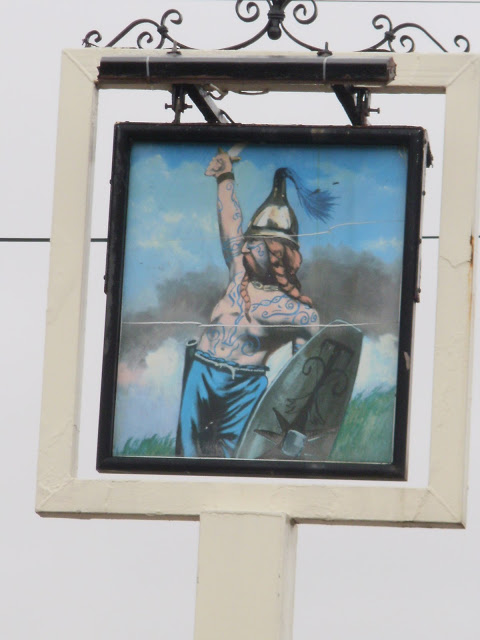
Today, the whole area is a council house estate, fittingly named the Woad Farm Estate, and the local pub is called The Woad Man whose sign (below) shows an ancient Briton with his face daubed in blue woad.


Friday, 13 September 2013

Update on the White Horse.

I recently received an email from T. J. Glendinning, a volunteer at Fydell House,  telling me that the White Horse that once
graced the front of the White Horse Hotel in West Street and now stands in the back garden of Fydell House was being
repaired and brought back to its former glory. With the email were three pictures of the horse, see below.
Thank you Mr. Glendinning.


The White Horse Hotel that once stood in West Street, the horse figure can clearly be seen in the centre of the building.
Dunhelms Shop now occupies this site.