VISITS

Saturday, 8 June 2013

Carriers Carts and Omnibuses.

Carriers formed a vital link between scattered communities prior to the coming of the railways in the late nineteenth century and even later in isolated rural communities, providing transport for goods and people between the various locations. They continued to trundle into Boston on market days - albeit in gradually diminishing numbers - throughout most of the 1920's and as late as 1932. They were to be found (amongst other places) parked for the day in that part of West Street near the end of Emery Lane, the old White Horse Hotel was in that area and some owners parked in the Hotel yard.

This picture, taken in West Street, Boston in February 1932, shows the Perseverance which was one of the horsedrawn carrier carts in Boston. The owner, Lawrence Richardson, is sat on it driving the horses Betsy and Daisy.
 
These carts, as E.P. Jenkinson remembered them were smallish (perhaps 10 ft. by 7 ft.)  horsedrawn, four wheeled, flat bottomed canvas canopied vehicles designed chiefly for the carriage of parcels and other packages, but which had a wooden form along each side to accommodate some seven or eight passengers.
 
A photo taken outside the main Post Office in Wide Bargate.
 
They really, I suppose, represented a kind of rudimentary rural bus service in the days before motor buses came to the town, which was (Mr. Jenkinson thought) in about 1922.
Boston's first Bus service was operated by a company called the Underwood Omnibus Company, replaced some three or four years later by the United Omnibus Company. Very soon afterwards, local enterprise in the person of a Mr. Smith augmented the area bus network with his "Smith's Safety Services" comprising two double decker buses proudly named "Lion" and "Lioness". By the late 1920's there was a reasonably adequate bus network throughout South Lincolnshire, although some of the more rustic routes only saw a bus on a couple of days a week, hence the continued existence of a few, at any rate, of the carrier carts well into the late 1920's.
 
Some of Boston's early buses, again outside the Post Office.
 
The late Harry Fountain, an old Bostonian, said fifteen public houses catered for the carriers and their horses by providing a big yard or frontage and stables. He recalled that the Corn Exchange Hotel (that once stood on the Marks and Spencer site) had six carriers on the frontage and put up 12 horses in 3 stables.
Some of the other public houses concerned were:
The Axe and Cleaver
The Cross keys
The Falcon
The Globe
The Kings Arms
The Peacock and Royal
The Ram
The Red Lion
The Red Cow
The Waggon and Horses
The White Hart and the
White Horse.

Tuesday, 4 June 2013

Nellie and Leslie, a Boston fishing smack.


The Nellie & Leslie story begins back in 1911 when a Boston fisherman, Mr Norris, known affectionately by the locals as ‘Sweet Tea’, commissioned a fishing smack from the Kings Lynn based shipyard of Wolfords, run by Gerald and William Wolford. The ship was completed and made its maiden voyage down to Boston in 1911 to serve Sweet Tea, who named the craft after his two children, Nellie & Leslie.

The Nellie and Leslie, moored up on the river down London Road, with the swing bridge in the background.
The boat was used for fishing anything from sprat to shrimp, and made regular trips into the Wash, and up the East Coast towards Grimsby on occasion too, serving Sweet Tea faithfully for over 20 years. Disaster struck the boat when it collided with another vessel in heavy fog in the Wash, and eventually sank. Fellow fisherman Albert Bagley heard about the wreck and decided to rescue the boat, returning her to Boston to patch her up. Albert used the boat from 1932, even equipping her with a Sherman tank engine sourced from GM, used in some of the earliest tanks during the war. “She was the fastest thing on the Wash at the time.” recalled Albert’s son, Ken, who worked on the boat alongside brother Steven until 1979. “She would achieve over 30 knots and was really well-known both in Boston and further up the East Coast at Grimsby docks.”

Her career on the Wash nearing its end, Nellie & Leslie was sold to a businessman from Lowestoft for just £250, and was eventually purchased by a trio of German marine engineers who were looking for an excuse to keep in touch following their engineering studies and were looking for a project on which they could work during their spare time.
As part of their fact-finding mission, the German engineers visited Boston, and met up with both Ken and Steven who remembered their workshop contained a few of the boat’s original elements, including the original sails.
“They went absolutely wild!” said Ken. “They were really keen that lots of reclaimed materials should be used, and the idea that their new engine could be supplemented by its original sails delighted them!”
The Germans took the sails back to Bremerhaven and made a final promise to Ken and Steven; they’d return to Boston to celebrate its centenary in exactly the same year that Ken and Steven Bagley’s father, Albert, would also have celebrated his 100th birthday.
The sailors kept their promise and sailed into Boston in 2011 with a much transformed Nellie & Leslie — the boat’s sale being made on the condition that its name would remain. Nellie & Leslie now boasted a brand new deck crafted in African teak, and a new Mercedes engine with 80hp.
It’s a dedicated pleasure craft, sailing at around 10 knots with seven tonnes of lead replacing the previous 10 tonne iron ballast. Inside, a 10 berth cabin replaced the previous 11 tonne fish hold, and now features a lounge area, galley and bathroom.
“It’s a beautiful craft.” said Müller. “We wanted to create a craft from which we could see the world, it’s a pre-retirement project but also something we can pass on to our children.”
The trio left Bremerhaven and sailed to England over the course of three days, being led into the Wash by Ken and Steven to celebrate the craft’s anniversary by spending five days in Boston.
“We fell in love with her!” said Alexander, who made the voyage with sons Vincent & Martin, and Max & Johannes Dellman. “Since buying her and restoring her, we’ve spent time sailing around the Baltic during our summer vacations.
We really didn’t expect such a warm welcome, and we had some really gorgeous weather with beautiful blue skies during the journey, so it really was a pleasure to bring the boat back to its home!”
The sailors were presented with a picture of Nellie & Leslie in her earlier incarnation, and were treated to a tour of Boston including some of the favourite pubs of the 23 fishermen then based in Boston, as well as a trip to the top of Boston Stump to enjoy a panoramic view of the Wash’s market town.
"We can’t believe how many came to see the boat, and some were even in tears as they’d worked on it or seen it in their youth.” said Alexander.

Saturday, 25 May 2013

End of the month bits and pieces.

A picture by F. Beales, photographer of Boston.
 
Claypoole's shop in Narrow Bargate.
 
The Finlay, a tug boat of old Boston.
 
Sorting 'Tates'.

Saturday, 11 May 2013

Bargains at the Regal.

In its golden era it was Boston's music-hall mecca. In the fifties, the age of the cinema, a seat in the one-and-nines for a Doris Day / Cary Grant movie, with a choc ice in the interval, was the highlight of the week for scores of local teenagers. In the 1970's it was the white elephant nobody wanted, and finally in July 1981, just five years after it closed its doors to cinemagoers, the Regal opened them again and some of its contents were sold off under the auctioneer's hammer.
Time had taken its toll, and inevitably, as the once proud and fashionable theatre had stood empty, decay had set in. The air was musty, the red plush seats had gathered dust, wallpaper in the foyer hung in sad loops from the wall, and windows that the vandals had left unbroken in the big swing doors were covered in graffiti written in the dirt that had gathered over five years.
About two hundred people went along, and there were some bargains too, if you happened to be in need of a five year old virtually unused generator, a mahogany grand piano, a 34 foot long portable cinema screen or a six way automatic ticket machine.

The Regal, after its closure as a cinema, became a small shopping centre on the ground floor and "Flames" nightclub in the upper part.
 
And for collectors of memorabilia wanting a permanent reminder of the Regal's  glittering heyday there were plenty of nostalgic souvenirs going cheaply.
A collection of old posters from the fifties and sixties leaned against the stucco wall in the stalls, a reminder of the bright, innocent shows and films that used to bring the customers flocking in. Ranged around were old posters for Mother Goose and Babes in the Wood, and for Millican and Nesbit.
On the stage amid a great sea of cable and rusty clutter were ancient mirrors, a plywood model commissionaire directing patrons to there seat numbers and nearby a genuine commissionaire's uniform and braided peaked cap, the wine coloured jacket mildewed and cobwebby.
Upstairs in the lounge, where, bargain hunters were told, the two large sofas were not for sale, there was more for souvenir hunters.
It was a sad afternoon for the Boston Scala Theatre Company, and for the Howden's, who had been involved locally in the theatre and show business for many years.
Mr. George Howden, brother of the Regal's managing director Mr. Ralph Howden, was there watching as its heart and soul were knocked down to the highest bidder. He began his theatrical career at the New Theatre in the Market Place in 1926, and at one time worked as a call-boy backstage at the Regal.
Brother Ralph, a familiar figure at the Regal for 40 years, was nowhere to be seen. "I think he prefers to keep away. He's had enough," said George.
Mr. Dudley Bryant, of Eley's, who conducted the sale said, "It was very successful. There was a lot of interest shown, both locally and from much further afield, and we had buyers who were theatre and museum owners from places like Humberside, Northamptonshire, Shropshire, Norfolk and Warwickshire."
After this the Regal struggled on in various forms, a ground floor shopping centre, a smaller cinema and as a nightclub. It was finally demolished in about 2005 and gave Boston yet another beautiful car park. (sarcasm).

Sunday, 5 May 2013

The Masonic Hall.


This unusual building, erected on part of  "Inlay's Garden" in Main Ridge, is a reproduction of the Temple of Dandour (The Divine Abode), one of the smallest Nubian temples.


The Greek motto over the door of the lodge is translated "Know Thyself," and the inscription in Egyptian hieroglyphics on the cornice reads "In the 23rd year of the reign of Her Majesty the Royal Daughter Victoria, Lady Most Gracious, this building was erected."

The main pillars each feature further inscriptions. On the left is, "Zetland was ruler of the Mysteries," and on the right, "St. Albans was ruler of the District when this building was dedicated to the God of Truth, who lives forever; in the year 1863, 5th month, 28th day."
Something went sadly wrong with the band on the day the hall was opened. A hymn had been specially written for the occasion by Boston's Coroner, Dr Walter Clegg. The Stamford Mercury reported: "It was intended to have been sung to the well known tune, Martin Luther's Hymn, but it was impossible to say what tune was adopted as the brass instruments indulged in a series of the most dismal discords, apparently having not the slightest reference to a single bar of music."
A more tuneful ensemble seems to have been engaged for that evenings masonic ball, for the 150 guests kept dancing "with great spirit until 5 o'clock in the morning."

Saturday, 4 May 2013

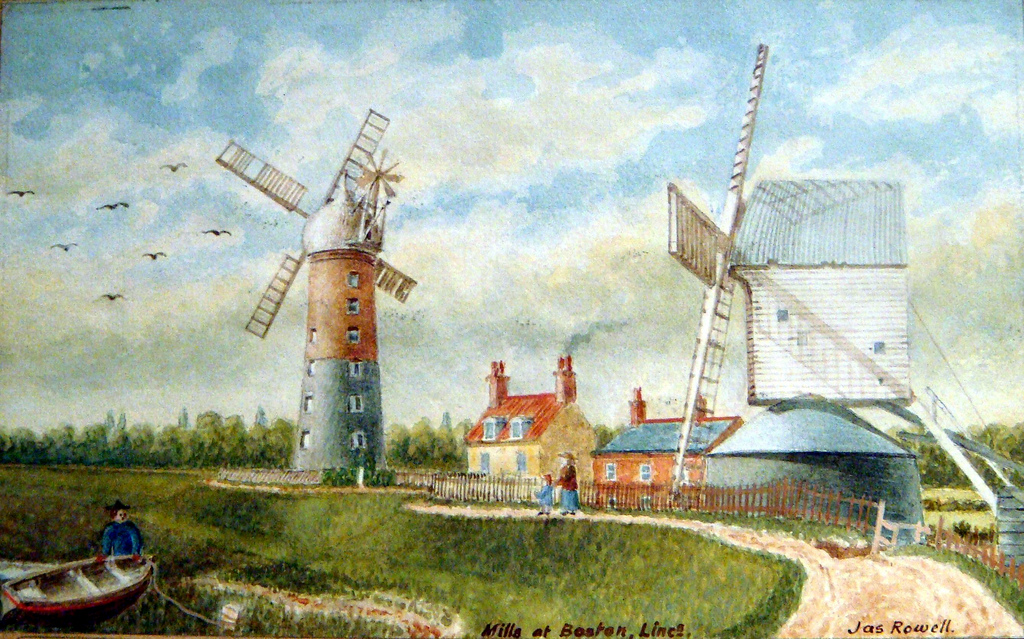
The Town's Mills.

Boston at one time was a maze of windmills, the one we all know is the Maud Foster Mill (the last one in the town) which has been restored to working order and is a fine sight when its sails are turning on a bright sunny day.

The Maud Foster Mill.
 
Behind the Maud Foster Mill once stood Mr. C Blade's old five sail mill, and nearby in Spilsby Road was the mill, built in 1780, which continued to be operated by the Thompson family until about 1930. One of the Thompson's, by 1843, had added to the original mill tower a large steam-driven mill, one of the first in this part of the country. The original Thompson Mill lost its top in a gale in 1860, and its five sails were replaced by four sails only. These remained in position until 1883 when they were sold to a waterworks company for pumping.

Thompson's Mill.
 
A second four sail mill which stood in Spilsby Road, near the present Mill Inn, was taken down in 1886.
In Wyberton Road was another four sailed mill and there was yet another windmill off George Street.
The Sleaford Road Mill lost its sails in 1905, could this have been the "Smock Mill" which stood "near the Turnpike Road to Sleaford?"

The Sleaford Road Mill.
 
Mr. Bonsor's  four sail "Pepperbox Mill" stood near Mount Bridge and also nearby was Tuxford's eight sail mill. When this was taken down its top and sails were taken to Heckington which, as a result, now boasts one of the only eight sail mills in the country.

The Pepperbox and Tuxford's eight sailed Mill.
 
Another view of Tuxford's eight sailed mill near Mount Bridge.
 
Finally (or were there any more?) on the site of the present dock basin were the Gallows Mills, they were near the old boundary between Boston and Skirbeck, and stood on or about the spot where there had been a gallows tree - a place of execution in medieval times. These were owned by Robert Bailey.
The Gallows Mills.


Friday, 3 May 2013

Showbiz at the old Corn Exchange Hall.


The Corn Exchange Hall was built in 1855 for the local farmers to carry out various corn transactions. After a time the farmers used it less and less, preferring to be in the Market Place, so the Hall was then used for many purposes, including auctions, concerts and dancing until Harry Fountain became the owner in 1900 when it became a theatre and had variety turns and was known as the Palace Theatre.

The Corn Exchange, built originally for farmers transactions.
 
In about 1907 Mr. Fountain went into partnership with Mr. Holly Thomas (a chemist and mineral water manufacturer) and they ran it for one year as a roller skating rink which, surprisingly, did not pay and Mr. Thomas drew out.

The Corn Exchange is the building with the large circle on it, behind this row of buildings in the Market Place.
 
Mr. Fountain then had the floor sloped and seats installed and ran it as a proper theatre. He employed a manager named Maurice Safrini who came from Hull and lodged at the Borough Arms pub in High Street, Boston.
This went on until about 1910 or 1912 when George Aspland Howden left his father, Ben Howden, with their travelling Bioscope Show and Gondolas. He wished to open and run Boston's first silent cinema, and its name was then changed to the New Theatre and later to the New Electric Theatre.


The opening on the right led to the Corn Exchange Hall.
 
Mr. Fountain still held an interest in the place, he dealt with the professional artistes travelling vouchers, weekly from the Corn Exchange Hotel which took its name in 1855 from the Hall.

The Corn Exchange Hotel, two doors away from the opening shown in the above picture.