VISITS

Showing posts with label witham. Show all posts

Tuesday, 8 January 2013

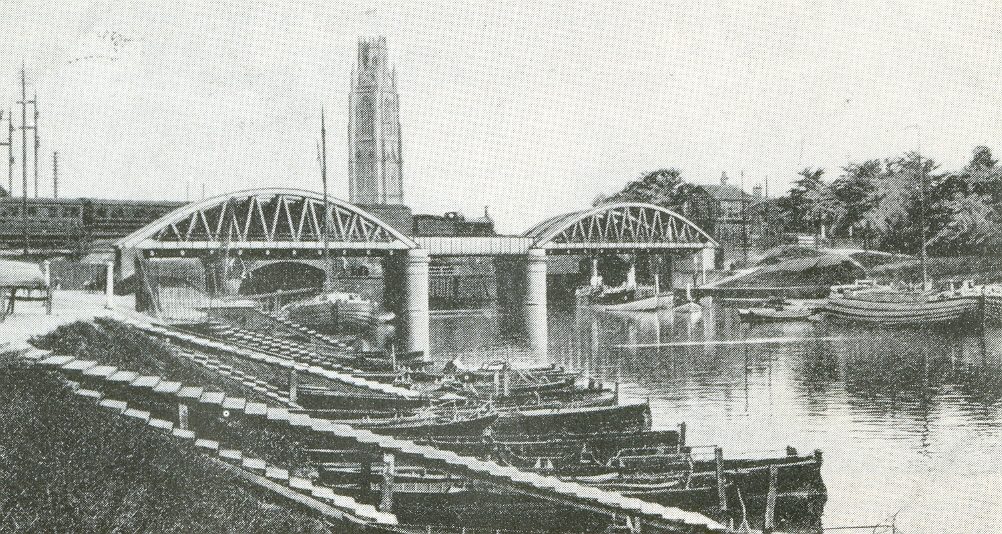
Boston's first railway bridge.

Below is a view of the first railway bridge in Boston over the River Witham, erected by the Great Northern Railway Company and opened for traffic on October 30th 1848. The bridge carried a single line of rails over the river in a sweeping curve. In the process of reproduction and reduction, interesting features of the original picture  have been more or less lost to view. Two trains, for instance, are seen travelling in opposite directions, on the opposite sides of the river, on a single line of rails. But as a railway official is seen waving a flag in face of the train approaching the point where the present level-crossing exists, it is to be supposed that all danger of a head on collision midway of the bridge was thus averted.
A good deal of shipping appears to be moored just beyond the Sluice Bridge, adjacent to the Railway Bridge. The old buildings on the left of the picture are old warehouses that later became Beeson's Glass Merchants and are now modernised and converted into housing accommodation. See second picture below for the warehouses at a later date.


Saturday, 16 June 2012

Before the railways came


Travel in Boston in the early 1700's was still something of an adventure, people did not often travel for pleasure and those that did travel went on horseback. For the people who had to travel and the transport of goods, there was, first of all, the stage coach.

Two coaches passing the Red Cow in Wide Bargate.

Stage coaches ran between London and York and stopped at Stamford and Grantham on the Great North Road. Boston was cut off from this great highway but in February 1786 it was announced that a stage coach to carry four inside passengers was to run three times a week from Spilsby, Boston, Spalding, Peterborough and Huntingdon to London. It took nearly a day and a half to get to London and stopped the night at Peterborough, leaving again at 5 a.m. next morning.

A stagecoach in the Market Place.

From July 1st. 1787 a diligence left the Peacock Inn, Boston on Sundays and Thursdays at 9. a.m. and went by way of Wainfleet to Skegness.

A coach outside The Peacock Hotel.

During the 1700's an increasing proportion of rough goods went by water. The Witham had always been the main link between Boston and Lincoln, and the means by which the goods shipped to the Port of Boston found their way into, and out of, the county. There was a good deal of coasting trade between Boston and London and boats regularly plied on inland waterways. This water transport was increasing right down to the coming of the railway. In an old Lincolnshire directory of 1821 there was advertised a steam packet running every day between Lincoln and Boston for both passengers and goods.

Very swiftly in the end the coach and river trade were overtaken by the railway which arrived in Boston in 1848.

Saturday, 1 January 2011

Pleasure boats and Steamers

Boston Regatta, 1888.
A pleasure boat near the Grand Sluice.

Rowland's boat hire.

Boats near the Sluice.

Above and below, Boats on the River Witham.


Above and below, the steam ship "Boston".


The steam ship "Bulldog".

The "Privateer" going past the New Park Inn.


Thursday, 25 November 2010

The Birch

In April 1900 an eleven year old boy, Frank Rear of 19, Witham Street, Boston was charged with stealing a watch, the property of Mr. John Perrin of Norfolk Place, Boston.
On market days Mr. Perrin had a stall in the Market Place and saw the accused and another boy loitering near his stall which among other things had three watches on it. He was very busy during the afternoon and when he finally came to a quieter time he noticed that one of the watches was missing and informed the police.

Boston Market.
John Broughton, seven years of age, of Colley Street, Boston told the court that on the Wednesday he went with his playmate, the accused, into the market. Frank stopped in front of a stall and said, “Shall we sneak a watch”, the witness saw him take a watch and identified the one produced. They then went to the pawn shop, Frank went into the shop and John stayed outside. Frank was given two shillings and sixpence for the watch and when he came out of the shop he handed John a shilling, two pennies and a half-penny. Frank Rear was found guilty and sentenced to receive six strokes with the birch rod.