VISITS

Showing posts with label wormgate. Show all posts

Saturday, 16 February 2013

Bits.


George Wilson, Grocer, on the corner of Red Lion Street and Wormgate. 1909.
 
 
Dion's butcher cart whose shop was in Pen Street.
 
 
Rona the Rat Girl at Boston May Fair.
 
 
The official opening of the Town Bridge 1913.


Sunday, 23 September 2012

September snippets.


This building, near Goodbarn's Yard in Wormgate, was once owned by the Barnard family and the large arch gave access to a riverside wharf. The family were brewers and owned a lot of public houses. They were also merchants who opened a bank in the 1790's but on 27 June 1814 they became the first bank in Boston to fail.

--------------------------------------------------------------------------------------------------------------------------


An old football programme advertising many forgotten Boston businesses including the Spick 'n' Span cafe, the Loggerheads pub and Cream Line Taxi's.

--------------------------------------------------------------------------------------------------------------------------


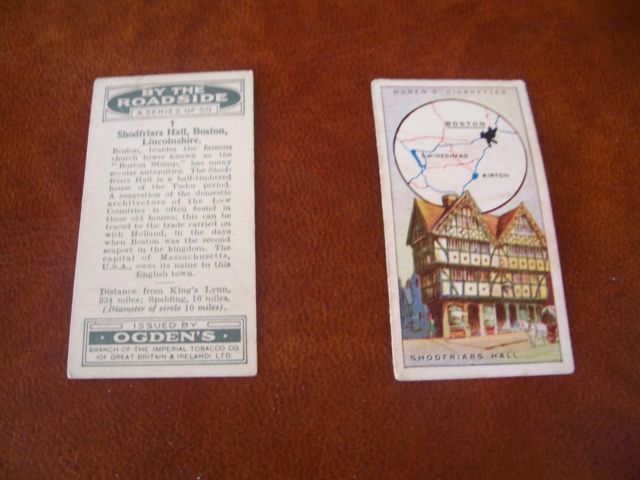
A cigarette card issued by Ogden's, a branch of the Imperial Tobacco Co. and showing Shodfriars Hall Boston.

--------------------------------------------------------------------------------------------------------------------------


An unusual view of Boston Market Place showing a flag flying from the top of the Stump.

--------------------------------------------------------------------------------------------------------------------------

Sunday, 15 April 2012

When the Germans conquered England


What's this? A German sentry at the top of Wormgate, which has a strange foreign name plaque?


German soldiers marching past the Blenkin Memorial Hall toward the Market Place?


No, these are stills from the film "One of our aircraft is missing" which was filmed during the second world war in Boston. They needed a Dutch town and of course couldn't go to Holland to get the real thing because the Germans occupied Holland at the time so, with Boston having some Dutch styled architecture, the Dutch scenes were filmed in Boston. Scenes of the Stump and of the swing bridge were also included in the film
Googie Withers played the lead feminine role


Tuesday, 6 March 2012

WORMGATE IN 1842 and 1854.

Mr. Victor Fox was born at 18 Wormgate in 1842.

He tells us that before the railways came to Boston in 1848 a lot of the trade with other places was done mainly by river navigation so many goods were landed near the Grand Sluice and brought into town through Wormgate making it a very busy street. He even remembered the grass growing between the pebbles in West Street while Wormgate flourished.


The chief business hotel down there was the Dog and Duck (later to become the Wormgate Inn and now Goodbarns Yard) and its smoke room was in much demand as a meeting place for the tradesmen from the Market Place. A bit further down the road the Packet House Inn was another favourite establishment.

Colley Street, one of the little lanes off Wormgate, was once the home of Tommy Howden who in his time was considered to be the best all round prize fighter in the locality. He was a lightweight and glaringly thin but although barely scaling ten stones he was a terror for many miles around. One of his memorable successes was against a giant of over six feet who answered to the name of Kiss Tebbs but who for all his length and breadth was brought down by the youthful Howden.

An unknown source left a description of Wormgate in 1854 from which I have been able to present the following.

Starting at the top end near the Stump where the present Vicarage stands was the Seven Stars Inn, the adjoining premises were occupied by Mr. Harvey a butcher and next came Miss Harvey a dressmaker.


The next building (now Goodbarns) was the Dog and Duck which in those days had the nickname of The Hotel Cecil and next door to that was Ernest Brown a bookbinder. The next place on the list is filled by Tom Ashby a baker and next to him was Miss Bucks Boarding School.


In quick succession now come Mr.Fox a dyer and shoemaker (Father of Mr. Victor Fox above), Mr. Fossett another baker, Mr. White a Tailor, Mr. Billiard a Butcher, Mr. Banks a shoemaker, Mr. Edward Spikins wood-turning workshop, Mr. Dring a shoemaker, Mrs. Harrison a sweet shop, James Reuten a barber, Mr. East a ropemaker, Mr. Fothergill a slater, Mr. John Baker a builder and paver, Mr. Massam a butcher and Mr. Wain a Tailor and General Dealer.

That side of the street finished we return to the Stump end and the opposite side where the Blenkin Memorial Hall is now.

The corner building was occupied by Mr. Atkin and next to him was Mrs. Swinn a confectioner known for her gingerbread and home made ginger ale. Next was Mr. Jay's Hat Emporium and next to him was Mr. Grantham a Tailor. A door further down was Mr. Ranyell a Joiner and Builder and then Mr. Julian a Butcher and Builder and at the Fountains Lane corner was Pickering's General Stores. On the opposite corner of Fountains Lane was Mr. Phillips a basketmaker. Next came in order of mention Messrs. Teesdale (tailor), Richardson (butcher), Peter Kitwood (grocer) John Peck (grocer and baker), Tuxford (watchmaker), The Packet House (Inn), Christopher Sewell (chemist), Edward Spikings (woodturner).

HERE IS COLLEY STREET.

At the opposite corner of Colley Street Sam Wells (carpenter), Milson (tailor), and Rainford (baker and miller)

HERE IS RED LION STREET

On the opposite corner of Red Lion Street was Miss Fox's high class boarding house and next door Mr. Harrison (brazier and tinker), the next property was taken up by the Laughton's Schools then Mr. Routen (painter) was next. The last few on the list are Mr. Barnes Milson (auctioneer and valuer), Chas. Kennigton (cabinet maker), and finally The Little Peacock Inn.

Monday, 27 December 2010

Wormgate

Wormgate is one of the oldest streets in the town. Its shape reflects its close association with the river, which was straightened in the early 19th century.

In the medieval period Wormgate was home to businesses run by many of the local, and not so local, monastic houses who exported their produce from their estates through the town. Fountain Lane, which connects Wormgate to Strait Bargate, was named after Fountains Abbey as the monastery owned a warehouse there.
During the 18th and early 19th centuries many grand houses were built with elaborate architectural detailing, also during this period many properties were established as schools, continuing a tradition begun in the medieval period when the Grammar school was situated in Wormgate and run by the town guilds.

Above : The former Grammar School in Wormgate.
From the end of the 18th century Red Lion Street developed and was named after the Red Lion Inn that stood on Strait Bargate. Housing began to be built along the narrow alleys that ran off the streets and this reached its zenith in the late 19th century when numerous small dwellings were constructed in the gaps behind the terraces occupying the street frontages.
Wormgate has always been an important commercial area and many of the buildings were used as shops or warehouses throughout its history. Inns, taverns and pubs have also been a common feature; the Wormgate Inn can trace its origins back to the 16th century when it was known as the Dog and Duck and the Little Peacock Inn was originally a waggoner's inn, frequented by wagon drivers bringing in produce from the northern fens.
Excavations on the corner of Fountain Lane in 1989 (below) revealed medieval buildings that may have been owned by Fountains Abbey.

Tuesday, 30 November 2010

Boston's Rasputin

In August 1920 Chas. Harlow, of Smith’s Court, Wormgate, Boston (reached by a passage at the side of 20, Wormgate) had an ejectment order granted against him by the local magistrates. Eleven years previously he is said to have vowed “I will never work again.” and that vow made at the age of about 35 altered the whole course of his life. He was then a fairly average citizen, with, it is said, at least £1000 to his name, and a wife and two children. In a family squabble the money went and since that time to 1920 he had lived apart from his wife and family and kept true his vow which brought him years of self imposed misery. The grounds of his ejectment from his two roomed tenement were filth and dilapidation.
Below left: Smith's Court, Wormgate Boston.

“Rasputin” was one of his nicknames probably from the fact of his dirty long hair which fell upon his shoulders with a beard to match. He didn’t use the upper room of his house and the “furniture” of the ground floor consisted of two boxes and some old potato sacks for a bed. The only ornamentation of his dwelling were twenty or so empty match-boxes on the mantelpiece.
The neighbours said that he retired to rest at about 5 p.m. and did not rise until about 10 a.m. when he made his appearance at the tap in the courtyard to get water for his meal of bread and cold water.
He often walked briskly around the town and was the object of much ridicule from the children of the town who called him “Crow’s Nest”. He was a pathetic figure, scantily attired in old greasy clothes in the coldest weather, and it was said he never had a fire. His hair and beard were never cut for he said it was against nature and that dogs, cats, beasts etc. never have their hair cut. Yet he was once a hairdresser!!

Sunday, 28 November 2010

One of our aircraft is missing

One of Our Aircraft is Missing (parts of which were filmed in Boston) is a 1942 British war film that was made under the authority of the Ministry of Information. It begins dramatically with the crash of "B for Bertie", a  Wellington bomber whose crew were forced to bail out over Holland after one of their engines was damaged during a night time raid on Stuttgart. It goes on to tell the story of how they are helped by the Dutch resistance.Many of the outdoor scenes set in Holland were filmed at Boston (as in 1942 the Germans still occupied the Netherlands) and many of the town's landmarks are visible in the film for example the quaysides, the Railway Swing Bridge (below) and the Church house at the top of Wormgate.


Monday, 22 November 2010

Windmills


According to the book "The History and Antiquities of Boston" there was a windmill in Wormgate, Boston as far back as 1591.
By the early 1800’s there were about a dozen windmills in and around Boston, many of them on sites that had been used for centuries. Pictured below are a few of these mills.

Above and Below: The Gallows Mills which were demolished when Boston dock was built. Skirbeck Church can be seen in both sketches.
The following three pictures show the "Good Intent" mill that stood down Sleaford Road. The first was drawn by W. Brand in 1796.


Below, the Good Intent in 1888.

Below, the Good Intent in 1967 when it was demolished.

Below can be seen Tuxford's Mill which was near Mount Bridge. There were eight sails on the mill and when it was demolished they were taken and put on the mill at Heckington where they are to this day.

Below: Thompson's Mill which stood down Spilsby Road.

And finally (below) the only one remaining in Boston, the Maud Foster mill.


Monday, 15 November 2010

Even more Pub pictures.

Eight more Pubs in Boston.

The Rum Puncheon and The Angel in the Market Place.


The White Hart near the Town Bridge.


The Rose and Crown (extreme right) on the corner of Witham Place and Union Place.


The King William IV on Horncastle Road.


The Queen's Head near Bargate Bridge.


The Three Tuns that stood on the corner of the Market Place and Church Lane.


The Wormgate Inn (now called Goodbarn's Yard).


The White Horse that used to stand in White Horse Lane.