VISITS

Showing posts with label rosegarth street. Show all posts

Monday, 9 September 2013

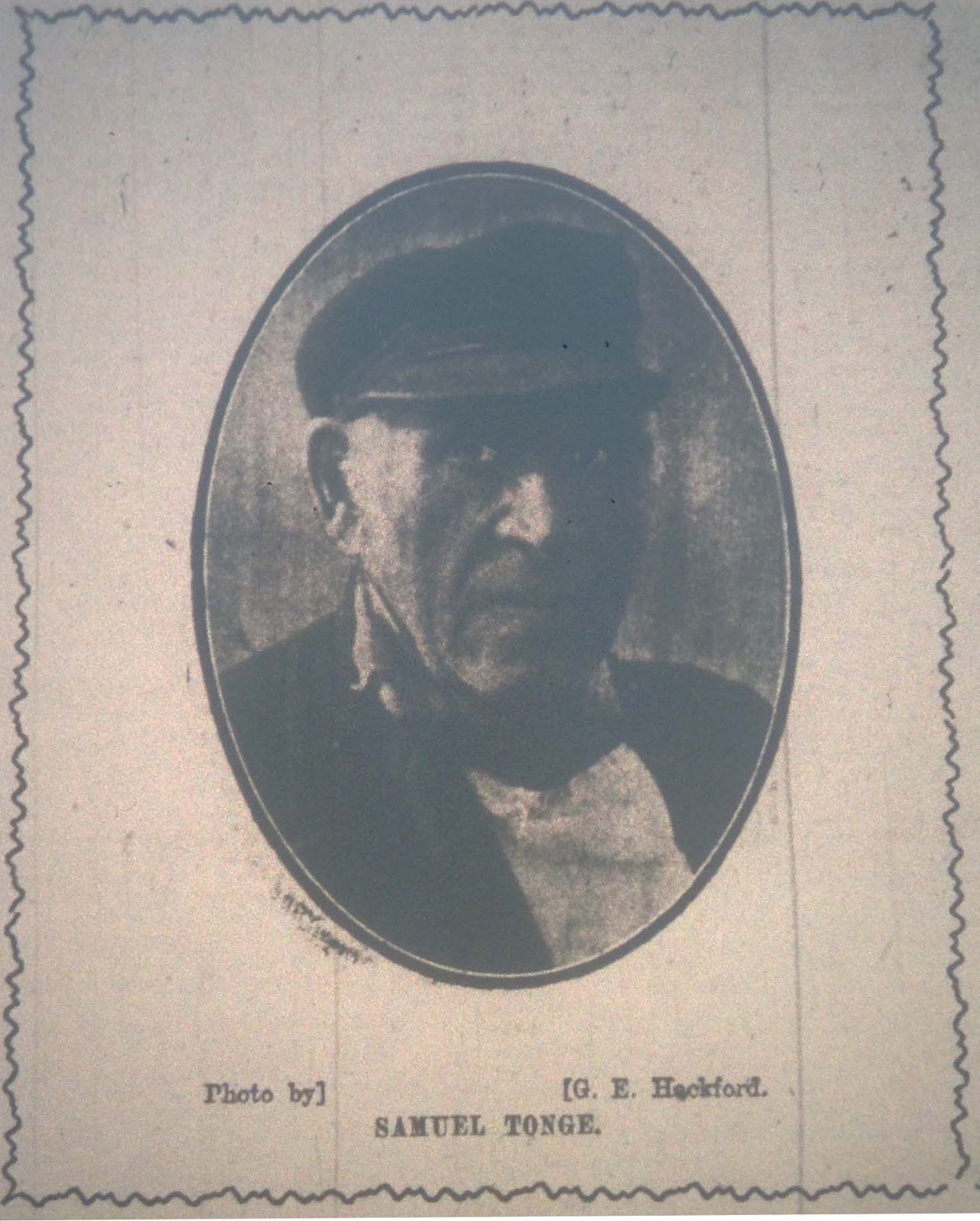
Sammy Tonge

In 1909 Samuel Tonge was Boston's oldest worker. Everyone who knew him and admired him called him Sammy and he was 87 years of age in 1909. When he was 3 months old his parents moved to Boston from Peterborough where he was born in 1822. His father was an agricultural labourer and Sammy's life was rough and hard, but he weathered every storm and enjoyed the best of health. He was at work every day, employed by the Corporation to look after the cleanliness of the pontoon on Boston Dock, and his work was a credit to himself and to those who employed him. The conscientious manner in which he discharged his duties was known to everyone who had business at the fish dock.
When he was a boy he worked for Mr Jones, a Cooper, in Rosegarth Street, for a shilling a week. At that time the price of bread was Elevenpence 'aipenny per quartern loaf and onion gruel was the popular fare at  breakfast. He and his parents were then living in the now departed "Groom's Alley*" Subsequently he went to work with his father on the land, and later was employed in a brickyard in Butt Lane*.

He didn't take to carrying bricks and so he ran away to sea. He went on Mr J. King's fishing smack for a start he was 13 years of age at that time. Afterwards he served on the "Daisy", of Boston, under Captain Lister, trading between Boston and Stockton, carrying corn from Boston to Stockton, and coals from Stockton to Boston. Then he was on the "Blessing", with Capt. Sissons, trading between Boston and Lincoln, and later he was mate of the schooner "Ellen," of which Mr. Baldwin was the skipper. He continued to go to sea until about 1889 when he obtained his position with the Corporation.
By 1909 Sammy was living with his son Chris, in Tuxford Terrace, Mount Bridge. He had been twice married and by his first wife he had four children all of whom were dead. He had been on a voyage in the "Princess Royal," of Hull, and returned from Oporto to receive the news that his wife and children had died during his absence. His second wife had died 16 years previously and by her he had 10 children, seven of whom, four sons and three daughters, were living, plus he had 29 grandchildren.
He was known to like singing his favourite song "The Lass o' Glasgow Town," and was once a champion hornpipe dancer.
The old age pension had just been introduced and asked if he had one he replied, "What do you think? I can earn my own living. I am an old sailor!" 

Groom's Alley is unknown to me.
Butt Lane is now Carlton Road.

Saturday, 12 March 2011

The Nine Row

Thanks to Rob Smith for the picture below. This row of old cottages were called the ‘Nine Row’ and they were located in the short section of Rosegarth Street that was on the opposite side of Lincoln Lane from the main part of Rosegarth Street.

When the fire station was moved from West Street to Lincoln Lane it stood on the wasteland pictured at the front of the cottages although by that time they had been demolished for many years.


‘Happy days, Boston 1928’ is etched on the negative of this picture taken outside one of the Nine Row cottages, Phyllis Cochrane (nee Betts) is standing on the far right. In the 1920’s the property was owned by George Pinches. His Great Niece said that the cottages were of poor quality and Mr. Pinches spent little money on improving them.

Wednesday, 2 March 2011

Lincoln Lane Area

During the 1960’s the Lincoln Lane area (almost opposite the Stump on the other side of the river) was demolished in preparation for redevelopment.

The Blue Lion on the corner bottom left, and the Victoria Inn on the far right corner.

The area included Irby Row, St. George’s Lane, Lawrence Lane, Leicester Square, Pinfold Lane, Stanbow Lane, Rosegarth Street and Lincoln Lane itself. Earlier demolition and the passage of time had already brought Lincoln Lane to its knees and from 1932 to 1961 between 75 and 100 properties had been pulled down by the Corporation or by their owners.


Many of the buildings and homes were up to 200 years old and four of the Stanbow Lane cottages were once used as a hospital.

The cottages that were used as a  hospital in Stanbow Lane.

When it was built the area was a prosperous place, boasting among other homes, two or three large merchant’s houses and gardens. It was mainly residential but later a few pubs (the Stag and Pheasant, the Hop Pole, the Victoria, the Blue Lion etc.) appeared as well, and then, as slum clearance produced waste land, shops were built and industry edged a foot in the doorway, including the shoe lace factory of Arthur Whittle and Co. Ltd., a slaughterhouse, George White’s saleroom and even the Fire Station had its home there but by 1961 there were fewer than fifty houses occupied.

Part of Lincoln Lane.

But what of the residents in 1961 that were told they would have to leave? At the Victoria Inn, Mrs. Agnes Berry, wife of the landlord said, “I’m not really bothered, but I know most of my customers are” she also looked back at some of the characters of the area she knew, there was Topper, (a chimney sweep who sported a top hat) Shetty, Weary butterfly, Sooty Sue, Old Pol Simpson, Old Nel Drury……….
At 13, Rosegarth Street, lived Tom and William Cushley, brothers (at 66 and 70 respectively) and both retired Corporation dustmen. Tom had won the Military Medal in the First World War and it was his fourth home in the area. He said, “We’ve both had 35 years on the ash carts. We live here happily together. It suits us and we’re never badly*. Course we don’t want to move!” “I spent four years out in France without a scratch. Now, after five years here they want me out, and it’ll be the fourth time.”
At 16, Rosegarth Street, Mr. and Mrs. W. Hough, with a growing family, took a different view. Said Mrs. Hough: “We’ve always lived in old houses and it will be a pleasure to get away from this and into a decent one. We’ve no bath and no electricity, and the place is damp.”

Rosegarth Street.

At her grocers shop in Lincoln Lane, Mrs. May Peacock, was worried. “I’ve been in this shop for 24 years, the ground opposite has been waste all that time and we want to know definitely what’s going to happen, and when. This shop is my living.”

The corner of Stanbow Lane and Pinfold Lane.
So, back to today, it was all eventually “rejuvenated” and on the characterless, red-bricked site now (2011) among other things are the Police Station, the Department of Employment, an empty Kwik-Save supermarket and the Bus Station.
*In Boston “never badly” means you’re never ill.

Thursday, 20 January 2011

Justice?

In December 1922 Olive Chester, a 25 year old single girl of 2, Black Tile Yard, Rosegarth Street Boston and Henry Yates, a 22 year old farm labourer from Gypsy Bridge were charged with indecent conduct on the Witham Bank (below) they both pleaded guilty.
The Chief Constable (Mr. Johnson) said the female prisoner had been repeatedly warned. The girls Mother said the Salvation Army Officer had offered to get her into a home and that the girl was weak minded.
The girl was sent to prison for a month with hard labour (the Chairman stating that she had declined to go into a home) and Yates was fined 20 shillings, or 14 days.

Witham Bank, Boston.